

Pakistan participates in world’s first Humanoid Robot Games in Beijing
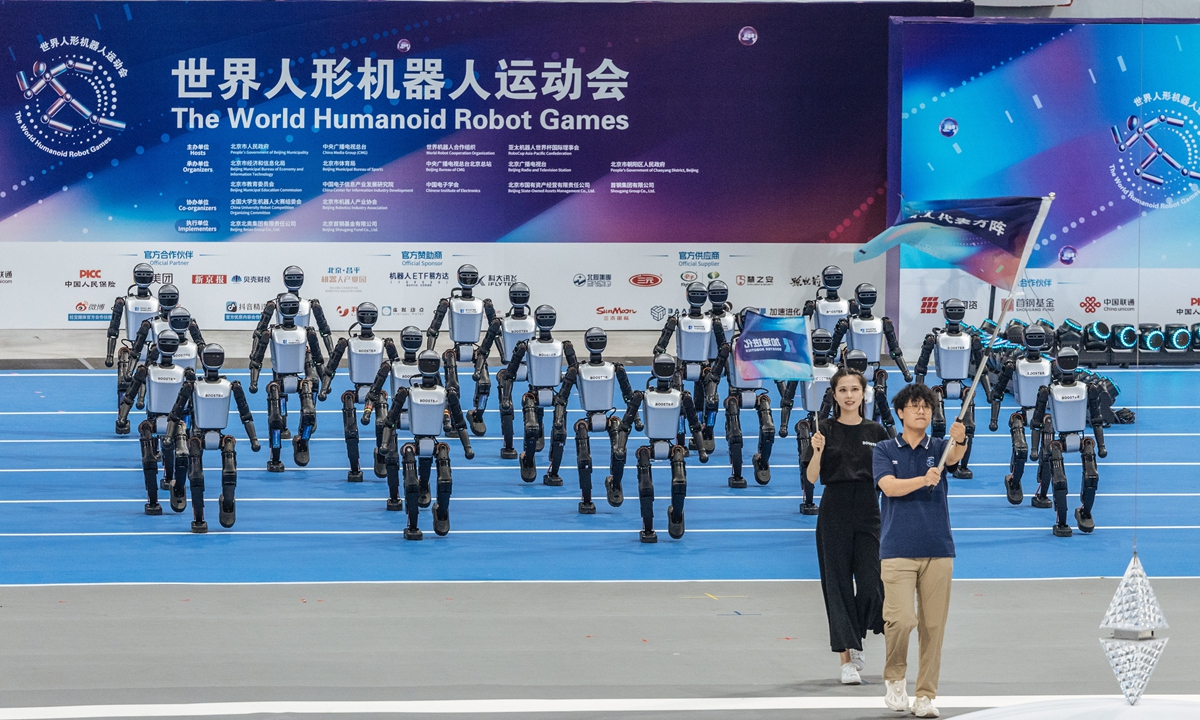
The inaugural World Humanoid Robot Games (WHRG) concluded in Beijing on August 17, marking the first global multi-sport event exclusively for humanoid robots. Featuring 280 teams from 16 countries and over 500 robots competing in 26 disciplines and 538 events, the games showcased both humor and innovation, from child-sized football matches to the 1500-metre race won by China’s Unitree H1. Notably, Beijing’s Tiangong robot impressed as the only fully autonomous runner. The event also hosted the RoboCup Asia-Pacific Masters, highlighting advances in swarm intelligence. Beyond competition, WHRG reflects China’s ambition to dominate global robotics, backed by a 1 trillion yuan (USD 214 billion) investment in AI and robotics startups.
BEIJING – The iconic China National Speed Skating Oval, popularly known as the Ice Ribbon, echoed with an unusual cheer: “Go! Go! Come on!”, but this time, the encouragement was not for human athletes. Instead, it was for steel-bodied competitors driven by advanced data and algorithms. The inaugural World Humanoid Robot Games (WHRG), the first multi-sport event exclusively for humanoid robots, kicked off in Beijing on August 14 and will end today (August 17). The groundbreaking event has brought together 280 teams from 16 countries across five continents, including Pakistan, Germany, Australia, the US, the UAE, Malaysia, and Brazil. More than 500 humanoid robots representing 127 brands are competing across 26 disciplines and 538 events, according to the organizing committee.
Among the most exciting competitions was five-a-side football, where child-sized humanoid robots shuffled across the pitch, often tumbling together in comic scrums. Yet, the highlight came during the 1500-metre race, where China’s domestic champion Unitree H1 stormed past its rivals, clocking an impressive 6 min 34.40 sec, well short of the human world record (3:26.00) but fast enough to clinch the first-ever gold medal of WHRG.
The Tiangong robot, developed by the Beijing Humanoid Robot Innovation Center, finished second in 6 min 55 sec and stood out as the only competitor to run completely autonomously without remote control.“This is just the beginning,” said an excited spectator. “Within the next 10 years, I believe humanoid robots will reach human levels in speed and dexterity.”
The games also feature the RoboCup Asia-Pacific (RCAP) Beijing Masters, regarded as the world’s top humanoid football competition. For the first time, a humanoid robot football match is being staged at an Olympic venue, marking a milestone in swarm intelligence and collaborative decision-making technologies.
The importance of WHRG extends beyond the competition itself. The International Federation of Robotics noted that Beijing has placed humanoid robotics at the heart of its national strategy. China has also announced plans to inject 1 trillion yuan (USD 214 billion) into AI and robotics startups, underscoring its ambition to lead the global robotics revolution.

China charts new growth path as ‘Two Sessions’ launch 15th Five-Year Plan era
BEIJING: China signalled a new phase in its economic strategy as the country’s top legisla…

Pakistan, China review regional security; Dar calls for dialogue amid Iran tensions
ISLAMABAD: Pakistan and China on Monday held extensive discussions on the evolving regional situation, …