

PM Shehbaz says Pakistan keen to increase space technology cooperation with China

Prime Minister Shehbaz Sharif has reaffirmed Pakistan’s commitment to expanding cooperation with China in space technology, emphasizing the strategic importance of this sector and China’s role as Pakistan’s most reliable partner. During a meeting with a delegation from Chinese firm Galaxy Space, he expressed interest in collaboration on space satellites, telecommunications, and satellite-based internet. Galaxy Space showed a strong willingness to invest and pursue joint ventures in Pakistan’s space industry. Highlighting bilateral progress, Pakistan plans to send its first astronaut to China’s space station (CSS) by 2026, with two candidates currently set to undergo training. Additionally, the recently notified ‘National Space Activities Rules 2024’ empower the National Space Agency to engage in international satellite data agreements, aligning with Pakistan’s broader push to develop space-based services, including through low-earth orbit satellites.
Prime Minister Shehbaz Sharif has expressed Pakistan’s desire to enhance cooperation with China in the field of space technology, a statement from the Prime Minister’s Office (PMO) said on Tuesday.
China’s space programme has rapidly advanced over the years, achieving milestones like the Tiangong space station and lunar sample-return missions. Its BeiDou satellite system and reusable rocket development underscore growing technological prowess.
Talking to a delegation from Galaxy Space, a Chinese space technology company, in Islamabad, the premier said that the country was “keen to increase cooperation with China in the fields of space technology, space satellite and telecommunications, and satellite-based internet.”
The premier also stressed that Pakistan was “giving utmost importance to the space technology sector”, adding that China remained the country’s “most reliable and strategic partner”.
The delegation, led by Galaxy Space Chairman Xu Ming, also “expressed keen interest in investing in Pakistan’s space technology industry, along with pursuing joint ventures with Pakistani space technology institutions and private telecom companies,” according to the press release.
In Feb, Prime Minister Shehbaz Sharif had said that Pakistan, in collaboration with China, would send its first space manned mission to China’s space station (CSS).
Under the agreement, two Pakistani astronauts will undergo training at the Astronaut Centre of China. One selected astronaut shall be trained as a scientific payload specialist, preparing for specialised research aboard the CSS. The selection process will be completed by 2026 to fly in an upcoming mission as per CSS planning.
The first Pakistani astronaut’s mission at CSS will involve conducting cutting-edge scientific experiments in various fields, including biological and medical sciences, aerospace, applied physics, fluid mechanics, space radiation, ecology and material sciences, among others.
In April 2024, the government had notified ‘National Space Activities Rules 2024’, applicable to space activities carried out within the territory of Pakistan, outside the territory if they are carried out on ships, vessels, or other airborne vehicles registered in the country and every person carrying out space activities and providing Space-based Services in Pakistan.
Under the rules, the National Space Agency (NSA) will be competent to enter into any agreements with foreign satellite operators to acquire, distribute, and sell foreign satellite data in Pakistan.
About six operators are currently providing satellite-based internet services globally, and new players are also entering the field; these include Starlink, Amazon, Oneweb and a Chinese operator.
Meanwhile, sources in the NSA said that the Chinese company, too, has obtained information to enter Pakistan’s internet market.
Low-earth orbit satellites provide satellite-based internet services, which can provide continuous broadcast or data coverage even in remote areas where radio towers or fibre cable networks are not present.
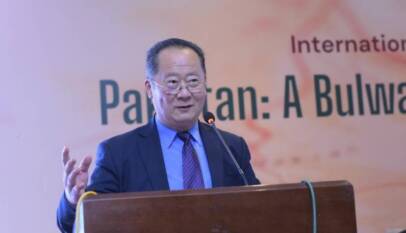


Pakistan indispensable pillar of regional stability: Chinese scholar
ISLAMABAD: Prof Cheng Xizhong, Senior Research Fellow at the Charhar Institute said on Wed…

Chinese firms plan to invest $2.6bn in Balochistan
ISLAMABAD: Chinese companies have announced plans to invest approximately $2.6 billion in Balochistan’s manufacturing sector, …