


ISSI hosts seminar on Pakistan–China ties, focuses on regional stability and economic growth

Speakers at a seminar on “Pakistan–China Relations: Regional Stability and Economic Prosperity,” organized by the Institute of Strategic Studies Islamabad (ISSI) and Fudan University, highlighted the China–Pakistan Economic Corridor (CPEC) as a transformative initiative driving Pakistan’s development and regional connectivity. ISSI Director General Ambassador Sohail Mahmood emphasized that Pakistan–China relations, rooted in mutual trust, remain a cornerstone of Pakistan’s foreign policy and that the China–Pakistan Action Plan (2025–2029) provides a roadmap for cooperation in technology, green growth, and innovation. Additional Foreign Secretary Ambassador Imran Ahmed Siddiqui noted that the next phase of CPEC would expand collaboration into artificial intelligence, biotechnology, renewable energy, and the digital economy, aligning with Pakistan’s URAAN Economic Transformation Plan. Participants in various sessions called for strengthening defence, maritime, and educational cooperation, expanding people-to-people exchanges, and linking CPEC with regional partners. Concluding the event, ISSI Chairman Ambassador Khalid Mahmood reaffirmed Pakistan’s commitment to fostering peace and prosperity through deeper collaboration with China.
ISLAMABAD – The China–Pakistan Economic Corridor (CPEC) is transforming Pakistan’s development outlook and helping connect the region, speakers said at a seminar on Tuesday.
The seminar, titled “Pakistan–China Relations: Regional Stability and Economic Prosperity,” was organised by the China–Pakistan Study Centre at the Institute of Strategic Studies Islamabad (ISSI) and the Pakistan Study Centre at Fudan University, China.
ISSI Director General Ambassador Sohail Mahmood said Pakistan–China ties remain the cornerstone of Pakistan’s foreign policy. He said the partnership, based on mutual trust and respect, has stayed firm despite regional and global challenges.
He said CPEC had strengthened Pakistan’s economic base and become a major driver of regional cooperation. He termed the China–Pakistan Action Plan (2025–2029) a forward-looking roadmap for working together in technology, green development, and digital innovation.
2nd phase of LDP starts
Mahmood said China’s peaceful rise had reshaped the global landscape and Pakistan fully supports President Xi Jinping’s development and security initiatives. He proposed a China–South Asia Summit, similar to China–Central Asia and China–GCC dialogues, to promote broader regional cooperation.
He added that the upcoming 75th anniversary of Pakistan–China diplomatic ties in 2026 would be an opportunity to set a new vision for the future.
Additional Foreign Secretary (Asia-Pacific) Ambassador Imran Ahmed Siddiqui, the chief guest, said the next phase of CPEC would open new areas of collaboration, including artificial intelligence, biotechnology, renewable energy, and the digital economy.
He said the initiative was in line with Pakistan’s Economic Transformation Plan (URAAN) and would create new opportunities for sustainable growth.
Sohail Alam hails Maryam as true guardian of Punjab
In a session on security cooperation, chaired by Ambassador Masood Khalid, participants discussed ways to build defence and security coordination. Adviser SPD Dr Zahir Kazmi suggested maritime safety networks and CPEC resilience exercises. Prof Wang Zhen from Shanghai said youth and education cooperation should complement defence ties.
Prof Huang Yunsong of Sichuan University called the China–Pakistan Action Plan a blueprint for future institutional linkages. He underlined the need to boost people-to-people contact through scholarships and training programmes.
The session on economic cooperation, chaired by Ambassador Naghmana Hashmi, looked at ways to expand CPEC’s regional outreach. Dr Ashfaque Hassan Khan of NUST proposed establishing SAECO Plus (China) and linking CPEC with Afghanistan, Central Asia, Iran, and Azerbaijan.
Dr Hassan Daud Butt of Bahria University said regional integration should move towards digital and renewable energy sectors. Chinese scholars Dr Wang Shida and Prof Zhang Jiegen highlighted potential in manufacturing and agriculture, while Dr Xie Chao of Fudan University said CPEC 2.0 should focus on smaller, community-based projects. Earlier, CPSC Director Dr Talat Shabbir welcomed participants, describing CPEC as a central pillar of Pakistan–China friendship.
In his closing remarks, ISSI Board Chairman Ambassador Khalid Mahmood reaffirmed Pakistan’s resolve to promote peace and prosperity through deeper cooperation with China.

CM Maryam Nawaz unveils tech-focused vision for Punjab’s youth
(Dunya News) – Punjab Chief Minister Maryam Nawaz Sharif has highlighted technology,…
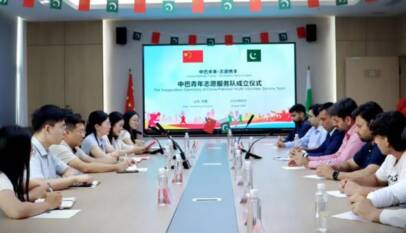
China-Pakistan volunteer service team launched to boost youth exchanges program
A China-Pakistan volunteer service team was inaugurated in Jinan, capital of Shandong Province, marking …