


Pakistan launches first Hyperspectral Satellite from China
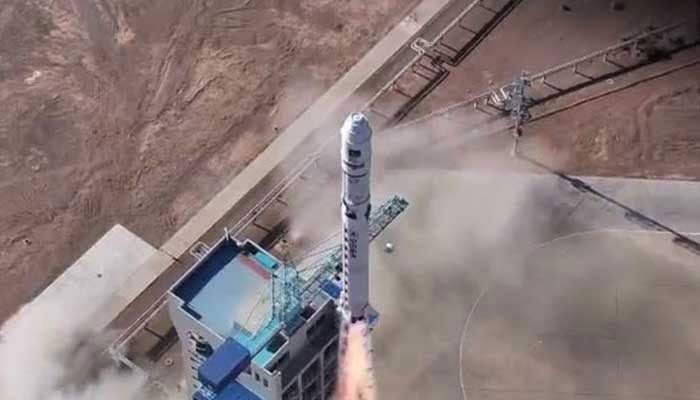
Pakistan has successfully launched its first hyperspectral satellite, HS-1, from China’s Jiuquan Satellite Launch Centre, marking a major milestone in the country’s space journey and National Space Policy Vision 2047. The launch, witnessed live from Suparco’s Karachi complex, was achieved with the collaboration of Pakistani scientists and engineers. The advanced satellite has entered its orbit and will undergo two months of in-orbit testing before becoming fully operational. HS-1’s hyperspectral imaging capabilities will enable detailed analysis of land, vegetation, water, and urban areas, revolutionizing agricultural planning, environmental monitoring, and disaster management. It will also assist in detecting deforestation, pollution, glacier melting, and geological risks linked to CPEC projects. The Foreign Office highlighted the mission as a symbol of Pakistan-China cooperation in peaceful space exploration, while Deputy Prime Minister Ishaq Dar praised the technical teams for their professionalism. With HS-1 following earlier EO-1 and KS-1 missions launched this year, Pakistan’s space programme has entered a new era of technological advancement and self-reliance.
KARACHI: Pakistan has launched its first Hyperspectral Satellite HS-1 from China’s Jiuquan Satellite Launch Centre (JSLC), with live scenes of the mission broadcast from Space and Upper Atmosphere Research Commission’s (Suparco) Karachi complex, the space agency said.
Preparations for the launch were completed in the presence of Pakistani scientists and engineers.
A Suparco spokesperson said the hyperspectral satellite has successfully entered its orbit. It may take up to two months to complete the satellite’s in-orbit testing; after two months, HS-1 will become fully operational, the spokesperson added.
According to the spokesperson, HS-1 will conduct detailed analysis of land, vegetation, water and urban areas. The advanced satellite is capable of capturing precise images across hundreds of spectral bands and is expected to revolutionise agricultural planning and environmental monitoring.
It will assist in monitoring deforestation, pollution and glacier melting, and help identify geological risks in CPEC projects, the spokesperson said.
Suparco Chairman Muhammad Yousuf Khan extended his felicitations to the nation, the spokesperson added, noting that the national project was made possible with the support of the Government of Pakistan.
The mission marks a major step towards Pakistan’s self-reliance in space technology, and HS-1 will place the country among emerging space leaders for sustainable development, the spokesperson said.
The spokesperson described the mission as a major milestone in Pakistan’s National Space Policy and Vision 2047.
In a statement, the Foreign Office (FO) said the successful launch of HS-1 from the Chinese Satellite Launch Centre is a major milestone and highlights long-standing Pakistan-China collaboration in the peaceful exploration of space.
The FO noted that HS-1 carries advanced hyperspectral imaging capable of capturing data across hundreds of narrow spectral bands. It will also contribute to development initiatives, including CPEC, by identifying geo-hazard risks and supporting sustainable infrastructure development, the statement added.
Deputy Prime Minister and Foreign Minister Ishaq Dar commended the scientists and technical teams from Pakistan and China working on HS-1 for their commitment, professional excellence and exemplary cooperation, MoFA said.
This is Pakistan’s third satellite launched into space this year, according to Suparco. The Suparco spokesperson said the earlier EO-1 and KS-1 missions were successfully launched and are fully operational in orbit.
Pakistan’s space programme, the spokesperson said, is entering a new era of advanced technology and applications.
The agency framed the mission as a major leap in Pakistan’s space journey, ushering in advanced applications across agriculture, disaster management, urban planning and environmental monitoring.
In agriculture, HS-1’s hyperspectral imaging is intended to enable precision farming through high-resolution data and calibration. By providing detailed insights into crop health, soil moisture and irrigation patterns, HS-1 is expected to enhance yield estimation by 15-20%, bolstering food security.



Sindh CM departs for China to attract foreign investment, boost local manufacturing
KARACHI – Sindh Chief Minister Syed Murad Ali Shah has departed for China on an im…

CPEC 2.0, GDI to unlock new development opportunities for Pakistan-China partnership
The Global Development Initiative (GDI) has played a key role over the past five …